

To Be an Effective Educator, Leave These Three Assumptions at the Door
By Abby Larson
November 2, 2026
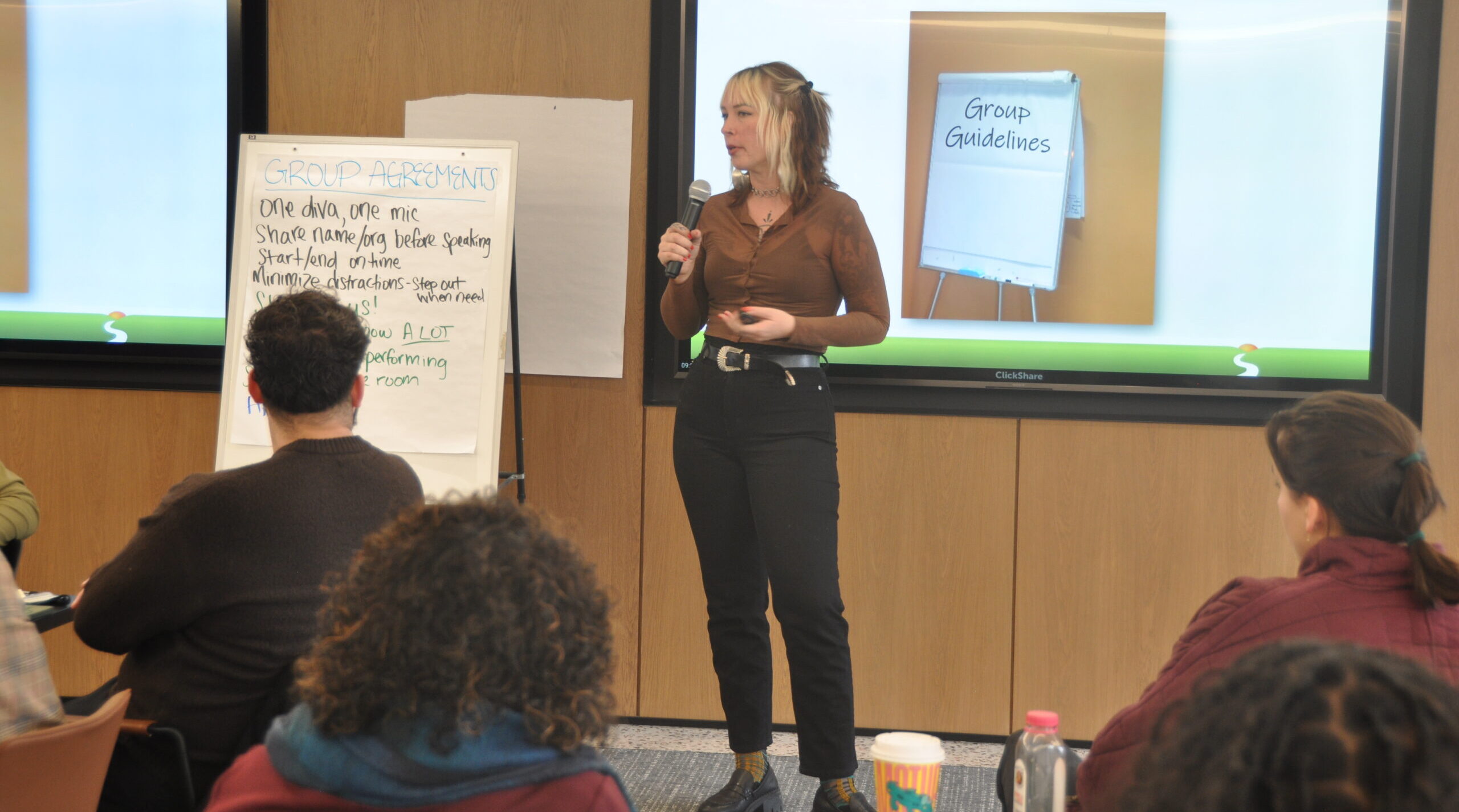
Leading trainings and facilitating productive discussions is a skill that many of us feel we have not had the dedicated time or tools to develop.
FUTURES’ Institute for Leadership in Education Development or I-LED, which has trained thousands of professionals in anti-violence work to hone their presentation skills and increase effectiveness, is here to help! We train what we call “Accidental Educators,” or professionals who work in the anti-violence space and understand the importance of being an impactful educator, but don’t have a background in teaching.
If you want to start thinking about ways to design an impactful learning experience, here are three common assumptions to leave at the door.
Assumption # 1: Expertise is Enough to Teach
This is a common trap for both new trainers and experienced ones. When you know a topic well, it’s natural to want to share everything and hope that your participants can absorb it. This is called the transmission model of education. However, if we want participants to do more than memorize what was said, we need to involve them in the process.
The shift: Knowing a topic well and teaching it well are two different skill sets. Learning is about designing something participants can actually walk away with and use.
In practice, this can look like:
- Building the session around practice, real-life application, and dialogue.
- Thinking about what your audience needs to be able to do their work differently.
- Encourage sharing by breaking participants into small groups to reflect on the information.
Assumption # 2: A Discussion Question Equals Engagement
Think about your own experiences: has a trainer ever asked a question that didn’t connect with you? Maybe you didn’t care about it, felt too much pressure to answer correctly, or found it confusing. Questions can fall flat for many reasons.
The shift: In Western education, we’re often taught to look for the right answer instead of the right question. We learn to memorize instead of exploring new ideas, and we get used to quick fixes and either/or thinking. Wanting to always have an answer and feeling anxious when we don’t can limit our creativity and fresh thinking (an idea explored well in The Art of Powerful Questions).
Discussion questions are just one tool, and they work best when used thoughtfully. In practice, this can look like:
- Asking participants to think about an experience they just had and asking them to connect what they learn to their real life.
- Encouraging reflection and identifying any shifts in thinking.
- Ensuring your participants know that there is not just one correct answer.
Assumption #3: Comfort Means Learning is Happening
It’s easy to think that if a session goes smoothly and everyone agrees, it was a success. But comfort doesn’t always mean learning is happening. Sometimes, making things too comfortable can actually prevent people from growing.
The shift: Good facilitation starts with what people already know, but it doesn’t end there. Growth means being willing to not know, to make mistakes, to ask “obvious” questions, and to practice even if you don’t get it right the first time.
In anti-violence and prevention work, the stakes for getting it wrong can feel really high. We work hard to create spaces that are trauma-responsive, healing, and safe. But sometimes, we try so hard to avoid discomfort that we remove the challenges needed for real learning. As Maurice Mitchell writes in Resilient Organizations, it can be infantilizing to “placate or pander instead of being in right relationship, which requires struggle, debate, disagreement, and hard work…As the saying goes, steel sharpens steel.”
In practice, this can look like:
- Resisting the urge to over-script learner behaviors with ground rules meant to prevent tension. Instead, prepare to handle hard conversations as they come up.
- Looking at mistakes as useful information, not as failures. Ask, “What can that teach us?”
- Asking learners to consider an issue or a challenge from a different perspective and find the shared value.
Many of us in anti-violence work are Accidental Educators, but with a little thought, a few good resources, and a shift in some of our thinking, we too can become intentional facilitators that guide lasting impact for the participants and their work.
About I-LED
The Institute for Leadership in Education Development (I-LED) strengthens the capacity of anti-violence and prevention educators to design and deliver training that works. Through practical workshops and technical assistance, we support U.S. Department of Justice Office on Violence Against Women (OVW) grantees and their partners in creating accessible, engaging learning experiences for the audiences they serve. We work with anyone who receives OVW funds or partners with an organization that does, including advocates, attorneys, social workers, judges, and community professionals.
Reach out to us at learning@futureswithoutviolence.org or visit our website at www.futureswithoutviolence.org/initiative/ILED
This project was supported by Grant No. 15JOVW-24-GK-03004-MUMU awarded by the Office on Violence Against Women, U.S. Department of Justice. The opinions, findings, conclusions, and recommendations expressed in this document are those of the author(s) and do not necessarily reflect the views of the Department of Justice, Office on Violence Against Women.